

Big, gorgeous shoulder muscles. They look good in tanks and stop traffic when a pump cover comes off. They protect your shoulder joint from injury, are essential for athletic performance, and they make everyday tasks just a little bit easier. Yes, please. To all of it.
Whether you’re interested in improving your physique for the aesthetic appeal, or you want to bulletproof your shoulders for athletic pursuits — volleyball, tennis, swimming, weightlifting — a cable system can simplify your routine. To help you tackle the right work for the job, we’ve got the best cable shoulder exercises to add to your upper body day.
Shoulder Anatomy
The shoulders are made up of bones, joints, muscles, ligaments, and tendons. The primary muscle targeted in most shoulder exercises is the deltoid, which has three heads: anterior (front), lateral (side), and posterior (rear).
Deltoid Heads
- Anterior Deltoid (Front Delts): Primarily responsible for flexing the arm, or bringing it forward.
- Lateral Deltoid (Side Delts): Primarily responsible for abducting the arm, or lifting it out to the side.
- Posterior Deltoid (Rear Delts): Primarily responsible for extending the arm backward and supporting external rotation.
While the deltoid muscle creates the upward movement of the arm — flexing, abducting, extending, and externally rotating — the rotator cuff creates downward and compressive forces to counterbalance the deltoid’s pull and keep the shoulder joint stable.
Rotator Cuff Muscles
- Supraspinatus
- Infraspinatus
- Teres Minor
- Subscapularis
Similar to the rotator cuff, other muscles that cross the shoulder joint or attach to the shoulder blade work together to support shoulder movement. These include the pectoralis major, latissimus dorsi, and trapezius.
5 Best Cable Machine Shoulder Exercises: How to, Benefits, and Muscles Worked
To help you build balanced and bulbous shoulders, here are the five best functional trainer exercises for strength, size, and shoulder health:
Internal/External Shoulder Rotation
If you’re on the path to building stronger, showstopping shoulders, it’s important to keep the various muscles, tendons, and ligaments surrounding the shoulder joint healthy.
Internal and external shoulder rotations are key exercises for shoulder health. They target the rotator cuff muscles, comprised of four small stabilizer muscles, which play a critical role in stabilizing the shoulder joint and helping prevent injury. With some minor involvement from the posterior delt during external rotations and the anterior delt during internal rotations.
How to Internal Rotation:
- Set the pulley around the height of your elbow.
- Face perpendicular to the cable machine and grab the D-handle with your closest arm.
- Bend your elbow at a 90-degree angle and lock it beside your waist.
- Keeping your elbow locked in place, rotate your arm inward and across your torso.
- Return to start with control.
How to External Rotation:
- Set the pulley around the height of your elbow.
- Face perpendicular to the cable machine and grab the D-handle with your outside hand.
- Bend your elbow at a 90-degree angle and lock it beside your waist.
- Keeping your elbow locked in place, rotate your arm outward outside of your body.
- Return to start with control.
Cable Face Pulls
Give your posterior deltoids some love while also targeting your upper back (the trapezius and rhomboids) with this isolation exercise. This movement also helps you to learn proper scapular retraction and depression, which can lead to safer presses and overhead lifts.
How to:
- Set the pulley to a position just above your head and attach a rope.
- Grab the rope from the outside and take two or three big steps away from the cable system.
- Pull the rope towards your face, leading with your elbows.
- Return to start with control.
Pro Tip: “If you want more trap emphasis, allow your scapulae to retract when you pull and protract when you return to start,” says Ashley Boyer ACE-CPT. “To keep the movement focused on your rear delts, try to keep your scapula stable throughout the movement while making sure to drive your elbows high and out.”
Cable Rear Delt Flys
The rear delt fly, also known as a reverse cable fly, targets the posterior deltoids — an often undertrained and underdeveloped part of the shoulder. Building strength in the rear delts with this move can help improve shoulder stability, support pulling movements, and assist with external rotation of the arm.
How to:
- On a cable crossover or functional trainer with two cable attachments, set the cable pulleys around eyeline.
- Stand between both pulleys, facing the cable machine. Grab onto the cable attachments with your opposite hands and take a big step back.
- Maintain a soft bend in your elbows as you pull the cables out and slightly down while slightly squeezing the shoulder blades at the top.
- Pause then return back to start, allowing your hands to cross over, with control.
Pro Tip: “Use a lighter load to minimize trap involvement and limit the use of momentum to complete your reps,” says Boyer.
Cable Lateral Raise
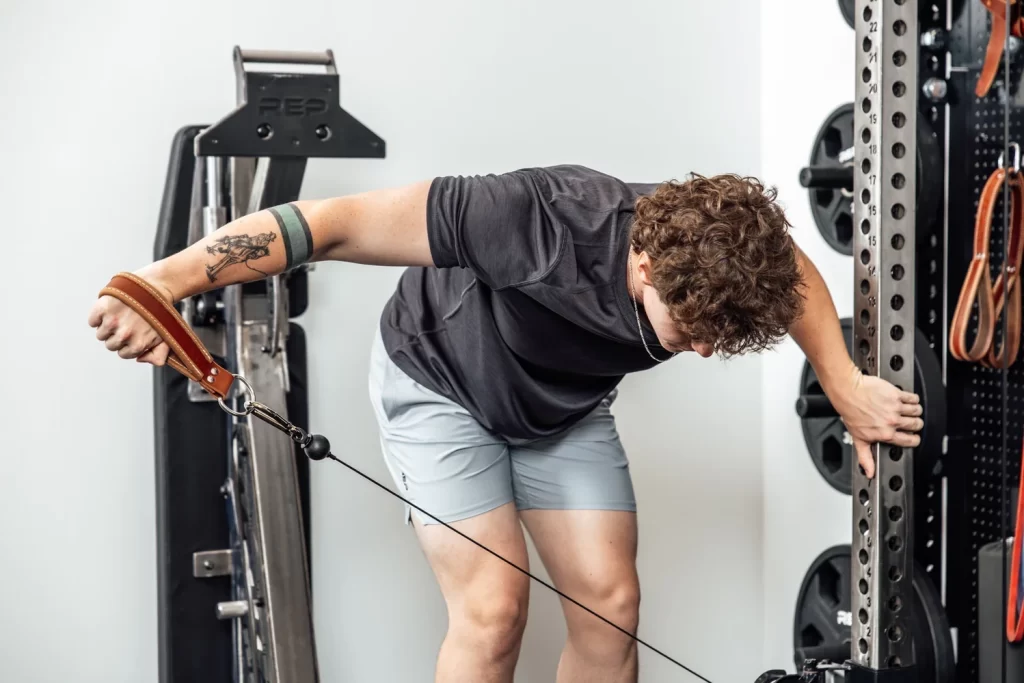
When you don’t have access to a lateral raises machine, cable lateral raises can help you target your side delts in a pinch. Building strength in this move helps with aesthetic goals of added width in your shoulder, supports shoulder joint stability, and aids in movements when you to lift your arms out to the side.
“Unlike how you’ve probably seen this move setup in the past, adjust the pulley so that it’s just below hip height rather than set on the floor,” says Boyer. “This will keep tension on your delts throughout the movement.”
How to:
- Set the pulley just below hip height.
- Step away from the cable machine and grab the handle with your outside hand — palm facing towards you.
- With your non-working hand, grip an upright and lean slightly away from the cable machine.
- Maintain a slight bend in your elbow as you lift up to shoulder height.
- Return to start with control.
Cable Shoulder Press
This compound movement primarily targets the anterior deltoids, while also utilizing the triceps brachii, trapezius, serratus anterior, rotator cuff muscles, and the upper pectoralis major.
How to:
- Set pulleys near the ground, stand between with feet shoudler-width apart, and grab the attached D-handles.
- Start with handles racked at your shoulder, back straight, and core engaged.
- Press the handles straight up overhead then lower them back to shoulder-height with control.
How to Program a Cable Shoulder Workout

A cable shoulder workout should target different muscles of the shoulder, while also featuring compound and isolation exercises. Exercise order is important to prevent injury, maximize performance, and to aid with your muscle building goals — whether that be strength or size. Before you jump in, kick things off with a 5 to 10 minute warmup, raising your heart rate and mobilizing your shoulders in preparation of your working sets.
Here are some sample functional trainer shoulder workouts for varying goals:
Hypertrophy Focused Shoulder Workout
For this program, start with the internal/external rotation to prep you shoulders for the work to come. Work with higher rep ranges to ellicit a hypertropic effect, making sure to finish your sets when you’d only be able to tackle one or two more reps.
- Internal/External Rotation — 2 sets, 15 reps/side (light load) (30 seconds rest)
- Cable Shoulder Press — 3 sets, 8-12 reps (1-2 reps in reserve) (90 seconds rest)
- Cable Lateral Raise — 3 sets, 10-15 reps (1-2 reps in reserve) (60 seconds rest)
- Cable Rear Delt Fly — 3 sets, 10-15 reps (1-2 reps in reserve) (60 seconds rest)
- Cable Face Pull — 3 sets, 10-15 reps (1-2 reps in reserve) (60 seconds rest)
Strength Focused Shoulder Press Workout
When strength is the focus, lower your reps and use heavier weights. However, isolation exercises like lateral raises, rear delt flys, and face pulls aren’t well-suited to traditional strength rep ranges. Because isolation exercises move through a single joint — think lying leg curls, leg extensions, and bicep curls — they’re not built for heavy lifting.
Loading them too much can throw off form, stress the shoulder joint, and reduce time under tension. Instead, start your workout with a compound strength lift while you’re fresh, then follow it up with moderate-weight isolation exercises.
- Cable Shoulder Press — 4-6 sets, 4-6 reps (2-3 minutes rest)
- Cable Lateral Raise — 3 sets, 10-15 reps (60 seconds rest)
- Cable Rear Delt Fly — 3 sets, 12-15 reps (60 seconds rest)
- Cable Face Pull — 3 sets, 12-15 reps (60 seconds rest)
- Internal/External Rotation — 2 sets, 15 reps/side (light load) (30 seconds rest)
Additional Cable Workouts
Why stop at shoulders? If you’re looking to tackle a full-body workout, check out these other cable machine program and exercise guides:
- Best Triceps Cable Workouts
- Benefits of Close-Grip Cable Lat Pulldowns
- How to Do a Seated Cable Low Row
- Full Body Cable Workout on The REP ARES™ Cable Machine
- Cable Tricep Extensions
Takeaway
We’ve put together cable machine shoulder exercises to help you build size, strength, and stability in your shoulders. Now that you’re armed with what to do and why to do it, tap in, setup your cable system, and get to building.
FAQs
What does shoulder press work?
Whether you’re working with free weights or a cable system, the shoulder press will primarily target your front and side delts, with some support from your triceps brachii, trapezius, serratus anterior, rotator cuff muscles, and the upper pectoralis major. Plus, your core muscles engage to keep you upright and stable.
What’s the best home gym cable system?
Choosing the best cable system for you depends on various factors — budget, space, desired training capabilitites, and more. However, the most versatile and useful cable system from REP is the REP ARES™ 2.0 cable attachment. It attaches to compatible power racks and gives you rack and cable system functionality.
Rosie Borchert is a NASM-CPT, former Nike Volleyball coach, and writer whose work has appeared on BarBend, Tonal, ABC, Netflix, and Amazon Studios. If anyone would like to hire her to play beach volleyball, snowboard, binge watch TV, or go climbing, please get in touch.
This article was reviewed by Ashley Boyer, ACE-CPT, for accuracy.